
Go to Joseph
25th Anniversary of the Consecration of Our Church
Of its 111 years, St. Joseph’s Church has served as a Catholic worship site for only 52 years. The church was built in 1914, but it immediately became a refuge during the First World War. After several years of functioning, in 1948 it suffered a tragic fate imposed by the regime of the time—expropriation and desecration (testimony: Memories of 1948).

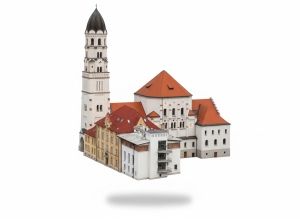 Since its consecration, the church has become a sanctuary for many people. Among them, the largest group consists of foreigners who attend Mass in English (EML). The church’s exceptional size offers opportunities for large gatherings of the faithful. Every year, an earthquake commemoration devotion is held here on Easter Sunday at 3 p.m. Many people and priests still gather for this occasion, and the archbishop leads the liturgy. The Jesuit-associated married couples’ group Najina pot (“Our Path”) also celebrates Mass here every October.
The church has excellent acoustics and is well-suited for choral concerts. St. Joseph’s has thus hosted numerous ensembles from around the world, who have found here not only a place for performance but also for recording music. The surrounding parish spaces offer hospitality to various groups, especially vulnerable ones. The church is also integral to other Jesuit missions within our broader pastoral work. It is a place of celebration for the Slovenian Province of the Society of Jesus, especially on the Feast of St. Ignatius, and for the Jesuit College, which traditionally opens and concludes each academic year with a solemn Holy Mass.
St. Joseph is especially dear to the members of the Nazareth Community, who care for the sanctuary and promote devotion to St. Joseph. Part of St. Joseph’s is also Mary’s Chapel, a warm and simple space—particularly welcoming in winter—where both the weekly and Sunday communities gather for Mass. For many years now, Sunday Mass has been celebrated at 4 p.m., attended by residents of the Retirement Home as well as an increasing number of others, including young people and families with children, who find here a peaceful and welcoming environment.
The church is large and appears empty. It has almost no decorative elements, apart from the impressive gilded statue of St. Joseph and Plečnik’s altar. Before the Second World War, it also had pews and proper liturgical furnishings. The hope remains—though it is difficult to imagine at present—that one day the church will fully come to life as initially envisioned. On the other hand, many visitors say that this emptiness allows them to pray more deeply. Perhaps one day this great church, which stands here as a monument to God’s favour to Ljubljana after the earthquake of 1895, will truly come alive in its fullness.